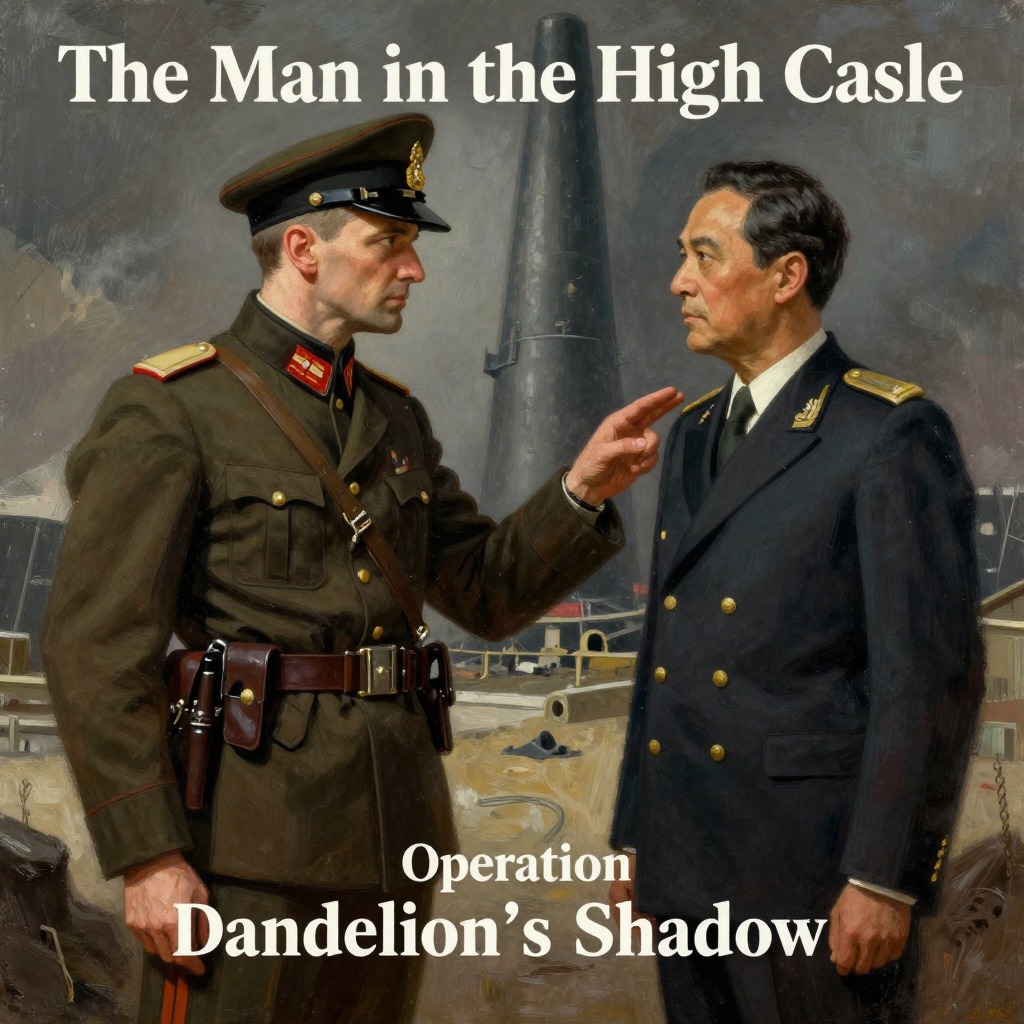
Operation Dandelion
Operation Dandelion is the clandestine German military plan for a massive, unprovoked nuclear strike against the Japanese Home Islands, intended to wipe out the Imperial family, the Home Defense Army, most of the Imperial Navy, and the civilian population and industry in a single blow. It is the central secret of the novel's geopolitical plot, revealed by the Abwehr captain Rudolf Wegener to the retired Japanese General Tedeki in San Francisco. The plan's existence, and the desperate attempt to prevent it, exposes the fragile alliance between the German Reich and Japan, the internal power struggles within the Nazi hierarchy, and the profound moral dilemmas faced by individuals like Nobusuke Tagomi who are caught in its wake.
The Plan and Its Purpose
Wegener, traveling under the cover name Mr. Baynes, reveals the plan to General Tedeki during their secret meeting in Tagomi's office. He describes it as a program called "Lowenzahn," the German word for Dandelion. The plan is a two-step deception. First, an incident is to be staged on the border between the Rocky Mountain States and the United States, where U.S. troops will be attacked and will retaliate by crossing the border and engaging the regular RMS troops stationed nearby. The U.S. troops are to be provided with detailed maps showing Midwest army installations. This manufactured conflict provides the pretext for the second step: a declaration by Germany regarding the conflict, followed by the dispatch of a volunteer detachment of Wehrmacht paratroopers to aid the U.S., which is itself further camouflage. The basic purpose, Wegener states plainly, is an enormous nuclear attack on the Home Islands, without advance warning of any kind. General Tedeki immediately grasps the objective: to wipe out the Royal Family, Home Defense Army, most of the Imperial Navy, civil population, industries, and resources, leaving the overseas possessions for absorption by the Reich.
The Political Context and Factions
The plan is not a unified policy of the Reich but a point of contention between rival factions. Wegener explains that certain groups in the Reich favor Operation Dandelion, while others do not. He was sent to plead for Japanese intervention, hoping that those opposing it could come to power upon the death of Chancellor Bormann. However, while he was in San Francisco, Bormann died and Doctor Goebbels was named Reichs Chancellor. Wegener confirms that Goebbels is an advocate of Dandelion. The faction standing opposed is led by SS General Heydrich. This opposition is not born of moral scruple but of bureaucratic rivalry. Wegener reveals that the administration of the East—the area held by Japan—would be given to the Foreign Office, with Rosenberg's people working directly with the Chancery. The police, who demanded authority, were turned down and instead were assigned the domain of space colonization on Mars, Luna, and Venus. Once this division of authority was settled, the police put all their weight behind the space program and against Dandelion. This rivalry, Wegener notes, was deliberately fostered by the Leader to ensure he was never challenged. The Wehrmacht, the military, is the sole possessor of the hydrogen bomb, and the blackshirts have only used it under Army supervision; in Operation Dandelion, all would be carried out by the Army High Command (OKW).
The Moral Dilemma and the Meeting
The meeting itself is a study in moral ambiguity. General Tedeki is horrified by the suggestion that Japan should support the Sicherheitsdienst, the most malignant portion of German society, to save itself. He states that the Emperor would never tolerate such a policy, regarding the Reich's elite corps as evil. Wegener counters with a cold realism, arguing that they must reflect solely on reality and actual power, not on ethical intentions. He suggests that the moral practices of the blackshirts exceed in ferocity that of the Wehrmacht, but their power is less. This logic forces Tagomi, who is present as a cover, to confront the paradox of their earthly situation: whether to assist evil in gaining power in order to save their own lives. Tagomi, already shaken by the day's events, feels ill and later reflects that the war, Operation Dandelion, will sweep them all away, regardless of what they do. He thinks that they should have fought the Germans, or permitted them to lose, assisting their enemies, the United States, Britain, and Russia. The meeting concludes with Wegener handing over a silver cigarette case containing microfilm of the notes from the German discussions as proof, and the general accepting it, but the moral stain of the proposed alliance remains.
The Aftermath and Wegener's Return
After the meeting, the SD raid on the Nippon Times Building forces the participants into a desperate defense, during which Tagomi kills two SD men. The plan's fate is left uncertain. Wegener, traveling back to Germany under the cover name Conrad Goltz, reflects that it is up to General Tedeki now to do what he can in the Home Islands. He is not optimistic, believing the Goebbels government will probably stand and turn once more to the notion of Dandelion. He contemplates the possibility that the Nazis, with their hydrogen bombs, might destroy everything, leaving a sterile ash, and that they may actively crave such a final holocaust. Yet he holds onto a belief that there must be other life somewhere, in some region or dimension they do not perceive. Upon landing in Berlin, he is met not by the Gestapo but by Waffen-SS men who take him to SS General Heydrich, who is alive and trying to strengthen his position against the Goebbels government. This suggests the opposition faction is still active. Wegener reflects on the terrible dilemma of their lives, where whatever happens is evil beyond compare, and yet they must go on, making a choice at each step, hoping and trying. The plan's ultimate fate is left unresolved, hanging on the outcome of the Nazi power struggle and the Japanese government's response to the warning.